The Perception of Time
We tend to discuss visual design in spatial terms. We speak of composition, of balance, of positive and negative space. We arrange elements on a static canvas, seeking a harmony that exists in a single, frozen moment. But what happens when the canvas itself is temporal?
Motion design works with how perception responds to change over time.
It is a practice that moves beyond the arrangement of objects in space to the choreography of meaning over time. In this context, time becomes a material with its own unique properties and potential. It can be stretched, compressed, layered, and fractured. It can be used to build anticipation, to reveal information, to construct a narrative, or to evoke a feeling.
Perceptual processing responds to relationships of objects in time, timing and order affect how information is interpreted and changes influence attention and memory. Each moment is a deliberate choice, a carefully placed element in a larger temporal composition.
Despite this, design practice often treats time as secondary to form, using it as a container for static elements rather than as an active design variable.
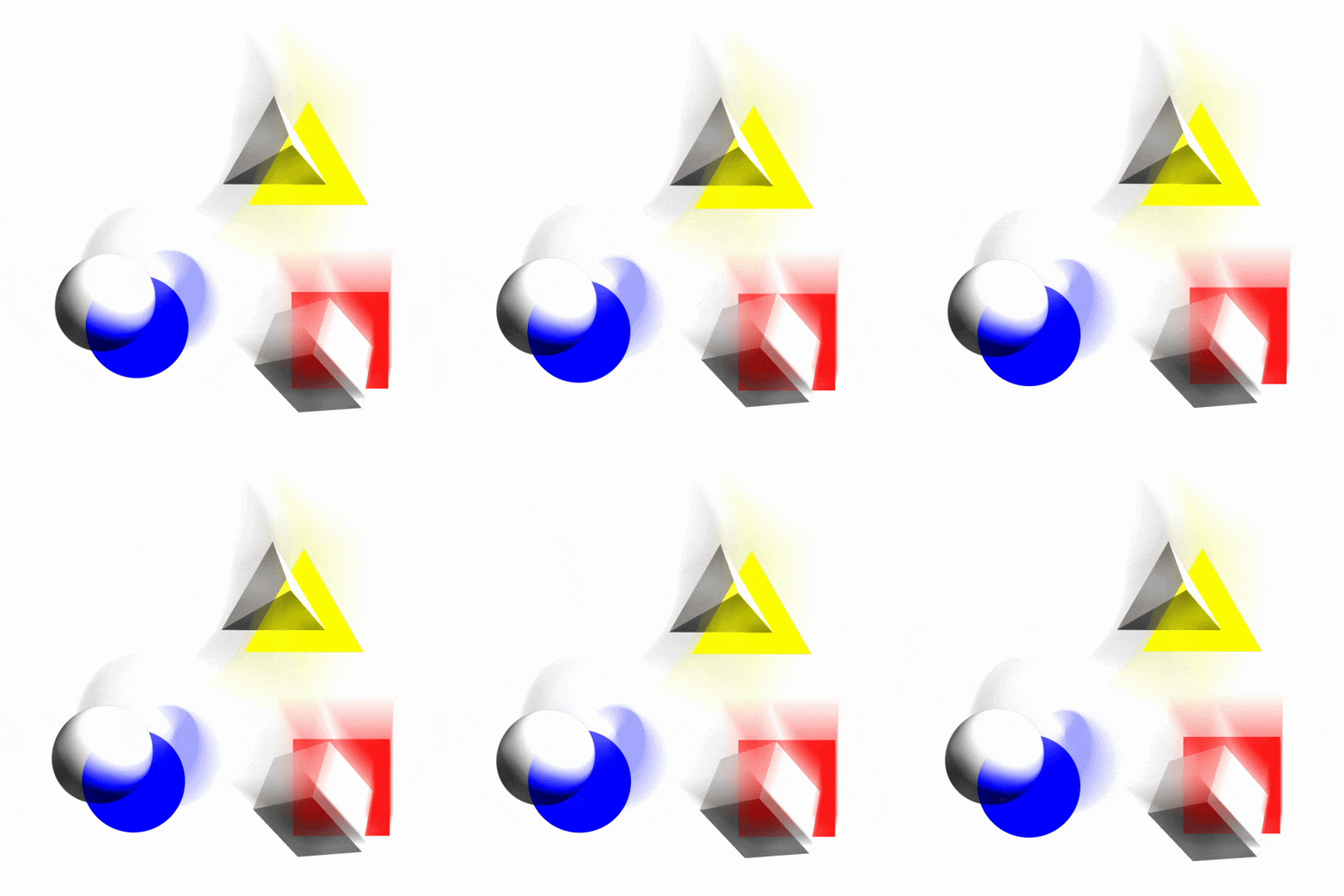
Design in Motion treats timing, rhythm, and duration as structural parameters. Any visual element introduced into time functions as an event. Its appearance, transition speed, and persistence influence how it is perceived and remembered.
This approach applies across time-based media, including motion graphics, broadcast identity, and immersive environments.
Immersive experiences operate on the same principle at larger scale. Space, light, and sound are coordinated over time to guide a visitor through a sequence of perceptual states. Each element’s timing, duration, and relation to others determines the overall arc. Tension, release, discovery, and resolution result from controlled appearance, persistence, and succession.
For more information, showreel and work examples please visit: https://design-in-motion.com
@2025 CAROLIN VEDDER
> Carolin Vedder Filmography, Broadcast, Identity and Title Design
For questions, collaborations feel free to reach out.
Thank you!